

Workers Comp Fraud Investigation Services in Florida
Table of Contents
What Workers Comp Fraud Investigation Services in Florida Actually Do
Workers' Comp Fraud Examples Adjusters See Most
Building Workers' Compensation Fraud Evidence That Holds Up
Chain of Custody and Documentation Standards
Inside a Workers' Compensation Surveillance Investigation
Licensing, Privacy, and Surveillance Boundaries
What a Surveillance Day Actually Looks Like
When Surveillance Is the Wrong Tool
A Realistic Workers' Comp Investigation Timeline
Choosing Between Surveillance, Interviews, and Records Review
How to Hire an Investigation Service: Step by Step
What Investigations Cost and What You Get
What Drives the Cost
What a Deliverable Package Should Include
How to Compare Quotes
Where the File Goes Next
Frequently Asked Questions
Last Updated: October 19, 2026
What Workers Comp Fraud Investigation Services in Florida Actually Do
Workers comp fraud investigation services in Florida exist to answer one question: is this claim what it says it is?
The job is documentation, not accusation. Investigators gather evidence. Carriers, employers, and prosecutors decide what to do with it.
Three things make up most of the work:
Claim review. Reading the first report of injury, medical records, and wage statements for inconsistencies.
Activity monitoring. Surveillance and field work to document what a claimant actually does.
Records development. Subpoenaed employment files, prior claims history, and witness statements.
Florida's framework matters here. Under Florida Statutes Chapter 440, workers' compensation fraud is a criminal offense, and the state pursues it through the Division of Investigative and Forensic Services. Investigators feed that system.
Workers' Comp Fraud Examples Adjusters See Most
The patterns repeat. An injured worker claims a disabling back injury, then posts a video of a weekend softball game. A claimant reports no income while running a side business. A medical provider bills for treatments that never happened.
Common workers' comp fraud examples include:
Exaggerated injury severity. Claimed limitations that don't match observed activity.
Fabricated work-related injury. An injury that happened off the job, reported as workplace.
Concealed employment. Working while collecting disability benefits.
Misrepresentation on claim forms. Wrong wage figures, hidden prior injuries, false addresses.
Provider fraud. Billing for services not rendered or unnecessary treatment.
What most guides miss is how often the fraud is small and sloppy rather than elaborate. A claimant who says he can't lift ten pounds, filmed carrying a kayak, is more common than a staged accident ring.
Watch Out Do not confront a claimant based on a single social media post. One photo rarely survives cross-examination. Carriers who move too early give the claimant time to build an explanation before the file is complete.
Building Workers' Compensation Fraud Evidence That Holds Up
Workers' compensation fraud evidence has one test: would it survive a deposition? Photos and a report aren't enough if the chain of custody is sloppy or the timeline has gaps.
Strong files share the same traits. Timestamps are continuous. Surveillance video shows recognizable faces and locations. The investigator's notes match the footage minute for minute. Every document has a clear origin.
Chain of Custody and Documentation Standards
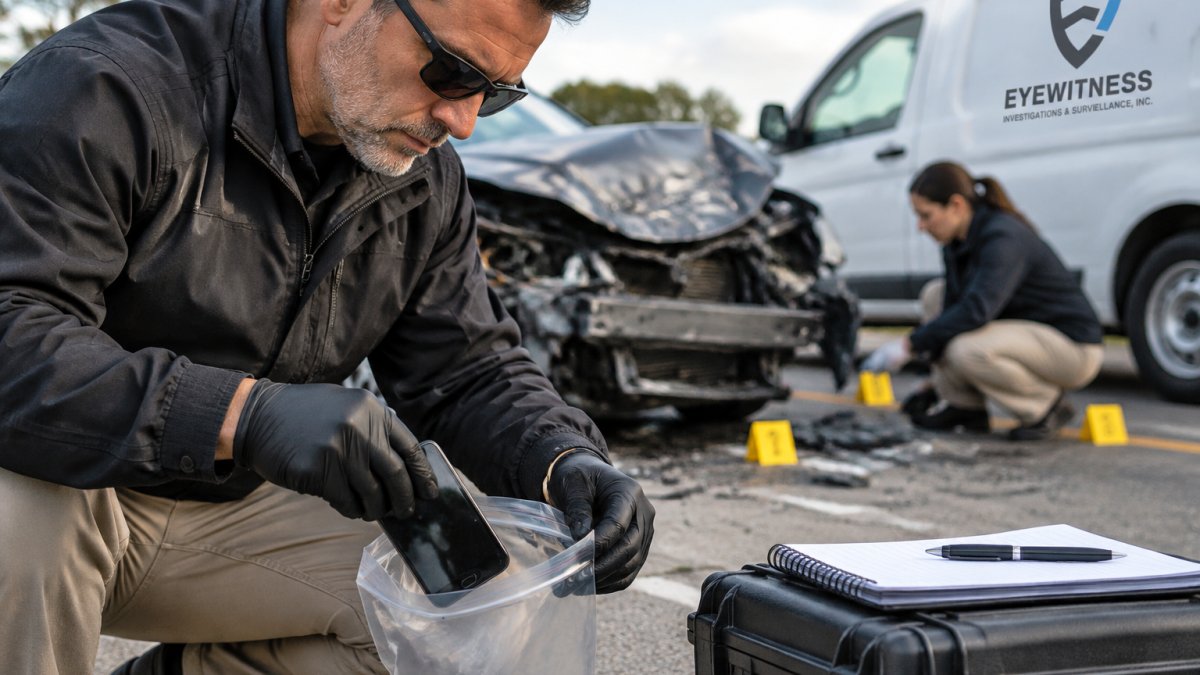
Chain of custody is the documented record of who handled evidence, when, and where. Break it and opposing counsel will attack the whole file.
What a defensible file includes:
Original, unedited media files with metadata intact
A written log of every transfer, viewing, and storage location
Investigator notes written the same day, not reconstructed later
Signed witness statements, not summaries
A clean separation between observed facts and investigator opinion
Pro Tip Ask any investigation service how they store original media. If the answer is "on the investigator's phone," walk away. Originals should be archived untouched, with working copies made for review.
Inside a Workers' Compensation Surveillance Investigation
A workers' compensation surveillance investigation documents a claimant's actual physical activity over time, using lawful observation from public places.

The work is unglamorous. Long waits. Early mornings. An investigator parked down the street from a claimant's home, watching for movement, filming only what happens in public view.
Coverage usually runs in blocks, often starting before dawn because that's when people leave for side work. Investigators log arrival, activity, duration, and departure.
Licensing, Privacy, and Surveillance Boundaries
This is where most guides go quiet, and where a file is most likely to be compromised.
Licensing. Florida requires private investigators and agencies to hold a state license, issued through the Department of Agriculture and Consumer Services.
Surveillance boundaries. Lawful surveillance happens from public property or with the consent of the property owner.
Records and pretexting. Medical records, financial records, and employment files have their own access rules.
Watch Out An investigator who trespasses or records a private conversation can taint the evidence and expose the carrier to a lawsuit. Ask for the license number and confirm it before work starts.
What a Surveillance Day Actually Looks Like
A typical surveillance block starts before dawn. The investigator arrives in an unmarked vehicle, confirms the subject's address and vehicle, and establishes a lawful observation point.
Investigators document what they see, not what they conclude.
Coverage is usually planned around the claim's disputed activity. A claimant who says she cannot sit for long periods is observed on a long drive.
When Surveillance Is the Wrong Tool
Surveillance answers questions about physical capability and public activity. It does not answer questions about prior claims history, conflicting employment dates, or whether an injury happened at work. If the dispute is documentary, a camera in a driveway will not resolve it, and the money spent on coverage is wasted. A good investigation service will tell you when surveillance is not the right first step.
A Realistic Workers' Comp Investigation Timeline
Most single-claim investigations run several days to a few weeks, depending on how much surveillance is needed and how fast records arrive. There is no fixed number, and any provider quoting a guaranteed timeline is guessing.
A typical sequence:
Phase | What Happens | Typical Duration |
Intake and claim review | File review, background checks, plan of action | 1-3 business days |
Surveillance | Early-morning and daytime coverage blocks | 2-5 days, often spread out |
Records development | Employment, medical, and prior claim history | 1-3 weeks |
Reporting | Written report, media, and evidence package | 2-5 business days after fieldwork |
Follow-up | Additional coverage if activity is inconclusive | As needed |
Records requests are usually the slowest part. Surveillance can wrap in days, but medical and employment records depend on how quickly third parties respond.
Choosing Between Surveillance, Interviews, and Records Review
Not every claim needs a camera. The right method depends on what's actually in dispute.
Surveillance fits when the claim hinges on physical capability.
Records review fits when the issue is history. Prior claims, conflicting employment dates, or a suspicious injury pattern show up in documents, not in a driveway.
Interviews and witness statements fit when coworkers or neighbors saw something. A signed statement from a supervisor who watched the claimant move furniture carries real weight.
A practical decision framework:
Claimed total disability plus a tip about outside activity? Surveillance first.
Suspicious prior injury history? Records review first.
Coworker reports inconsistent behavior? Witness statements, then surveillance to corroborate.
Conflicting statements in the file? Interviews and recorded statements.
Key Takeaway The cheapest investigation is the one aimed at the right question. Match the method to the dispute, not to habit.
How to Hire an Investigation Service: Step by Step
Hiring well takes about a week of diligence and saves months of headaches.
Define the question. Write down exactly what you need to know. "Is she working?" is a question. "Investigate her" is not.
Confirm licensing. Ask for the agency license number and verify it with the state.
Ask about evidence standards. How are originals stored? Who writes the report? Will the investigator testify?
Get a written scope and fee structure. Flat fee, hourly, or retainer. Get it in writing before work begins.
Set a communication schedule. Agree on check-in points and what triggers a scope change.
Review a sample report. Ask to see a redacted example of their reporting format.
Confirm confidentiality. Ask how files are secured and who has access.
At Eyewitness Investigations & Surveillance, our team has handled investigative work since 1992, led by a retired law enforcement officer with 20 years of service and 17 years as a traffic homicide investigator.
What Investigations Cost and What You Get
Costs vary with scope, but retainer-based pricing is common. Eyewitness Investigations & Surveillance offers surveillance retainers starting at $2,400 and investigation packages from $500 to $3,400, depending on the work involved.
Those numbers only make sense once you know what drives them. A quote that looks low on the front end can cost more once testimony, records, or extended coverage are added. A quote that looks high may include work another provider bills separately.
What Drives the Cost
Surveillance hours. Coverage is usually billed in blocks, and early-morning or multi-day coverage adds up. A single block is cheaper than a multi-day pattern, but a single block is also easier to explain away.
Records development. Subpoenaed employment files, prior claims history, and medical records take time and sometimes third-party fees. Records-heavy cases cost more than surveillance-only cases.
Travel and geography. Investigators working outside their home area charge for travel time and mileage. Remote or spread-out locations cost more.
Reporting complexity. A short factual report with a few clips is different from a multi-day timeline with synchronized media and a records summary.
Testimony. Deposition and court appearances are usually billed separately, often hourly with a minimum. Ask upfront whether testimony is included or billed separately.
Pro Tip Ask upfront whether testimony is included or billed separately. A file that saves money on the front end can cost far more when the investigator charges for court time later.
What a Deliverable Package Should Include
A defensible package is more than a report and a video file. Ask for a sample redacted report before you engage, and confirm the package includes:
A written investigative report with a clear factual narrative, separated from investigator opinion
Time-stamped photo and video media with original files preserved and working copies for review
A chain-of-custody log showing who handled evidence, when, and where
Witness statements where applicable, signed rather than summarized
A records summary with sources identified
Investigator availability for deposition or testimony, with the fee structure stated in writing
How to Compare Quotes
Quotes are hard to compare line by line because providers scope differently. The practical approach is to normalize them: ask each provider for the same written scope, the same fee structure (flat, hourly, or retainer), the same deliverables list, and the same testimony terms.
A provider who will not put scope, fees, and deliverables in writing before work begins is telling you something about how the engagement will go.
Where the File Goes Next
The Florida Division of Investigative and Forensic Services handles criminal referral when evidence supports it. Your investigation file is what makes that referral possible, which is why the quality of the package matters as much as the price. A cheap file that cannot survive a deposition is not a saving; it is a do-over.
Frequently Asked Questions
Who investigates workers' compensation fraud in Florida?
Several parties can investigate. Insurers and self-insured employers typically start with their Special Investigations Unit, then bring in licensed private investigators for field work and surveillance. The Florida Division of Insurance Fraud handles criminal referrals, and the Division of Workers' Compensation within the Department of Financial Services oversees the system. For prosecution, cases move to state attorneys. Most claims start with internal claim review and escalate to outside workers comp fraud investigation services when red flags appear.
How long does a workers' comp investigation take?
It depends on the method. Records review and database checks often finish in days. A focused surveillance assignment usually runs three to five days of coverage spread over one to three weeks, with a report delivered shortly after. Complex cases involving multiple subjects or out-of-state activity can stretch longer. Ask any provider for a written estimate of coverage days and report turnaround before you sign, so the workers' comp investigation timeline is clear from the start.
What can a workers' comp investigator legally do in Florida?
A licensed investigator can conduct surveillance from public spaces, record video and photos where there is no reasonable expectation of privacy, interview witnesses, pull public records, and document activity. They cannot trespass, enter a home without consent, impersonate law enforcement, or use pretexts that violate privacy law. Florida regulates private investigators through the Department of Agriculture and Consumer Services, so confirm the license before hiring anyone for workers' compensation surveillance investigation work.
When should an insurer or employer hire a private investigator?
Hire one when claim review turns up inconsistencies: activity levels that do not match reported injury severity, missed medical appointments, conflicting witness statements, or social media posts showing physical activity. Also bring in outside help when an injured worker refuses light-duty offers or changes doctors repeatedly. Early referral matters because workers' compensation fraud evidence is perishable. Documented return-to-work activity captured in the first weeks is far more useful than footage gathered months later.
Workers' comp fraud rarely announces itself. It shows up as a claim that doesn't quite add up, and the difference between a closed file and a referred case is usually the quality of the evidence behind it. Eyewitness Investigations & Surveillance provides licensed, statewide investigative and surveillance work built for insurance and legal proceedings, with documented evidence, discreet fieldwork, and reporting designed to hold up under scrutiny. Book now and get a factual record you can act on.
Book Now

Comments