

Private Investigator for Personal Injury Claims
Table of Contents
Private Investigator for Personal Injury: How They Build Your Case
What Investigators Can and Cannot Establish
Private Investigator for Car Accident: Evidence Gathering After a Crash
Witness Statements and Scene Documentation
Insurance Claim Surveillance: How Investigators Verify Injury Claims
What Surveillance Actually Documents
The Legal and Ethical Limits That Protect the Case
How the Findings Reach the Attorney
Traffic Accident Investigation: Reconstructing What Happened
What a Reconstruction Actually Uses
Evidence Handling and Courtroom Use
How This Coordinates With Your Attorney
Private Investigator Cost for Injury Case: Budgeting and Billing Models
How to Choose and Vet a Private Investigator
Legal and Ethical Limits of Surveillance in Personal Injury Cases
Conclusion: Using Investigation Evidence to Strengthen Your Claim
Frequently Asked Questions
Last Updated: October 16, 2026
Private Investigator for Personal Injury: How They Build Your Case
A private investigator for personal injury is a licensed professional who gathers evidence to confirm or challenge the facts behind an injury claim.
Here's the core idea: most injury claims rise or fall on facts, not opinions. An investigator's job is to nail down those facts before they reach a courtroom or an adjuster's desk.

What Investigators Can and Cannot Establish
Investigators can establish facts. They cannot decide the case.
That distinction matters. A good investigator documents what a claimant does, where they go, and how they move. They collect photographs, video, witness statements, and public records. What they cannot do is prove someone is lying, diagnose an injury, or force a settlement.
So the work stays narrow and factual:
Confirm or challenge claimed physical limits
Document daily activities and mobility
Locate witnesses and take statements
Pull public records and background details
Build a timeline of events
Many attorneys treat this as fact-finding, not proof. The evidence supports a legal case; the attorney argues it.
Private Investigator for Car Accident: Evidence Gathering After a Crash
After a crash, evidence disappears fast. Skid marks fade. Witnesses move. Surveillance footage gets overwritten.
A private investigator for car accident cases focuses on capturing that evidence before it's gone. This is where speed matters more than anything else.
Witness Statements and Scene Documentation
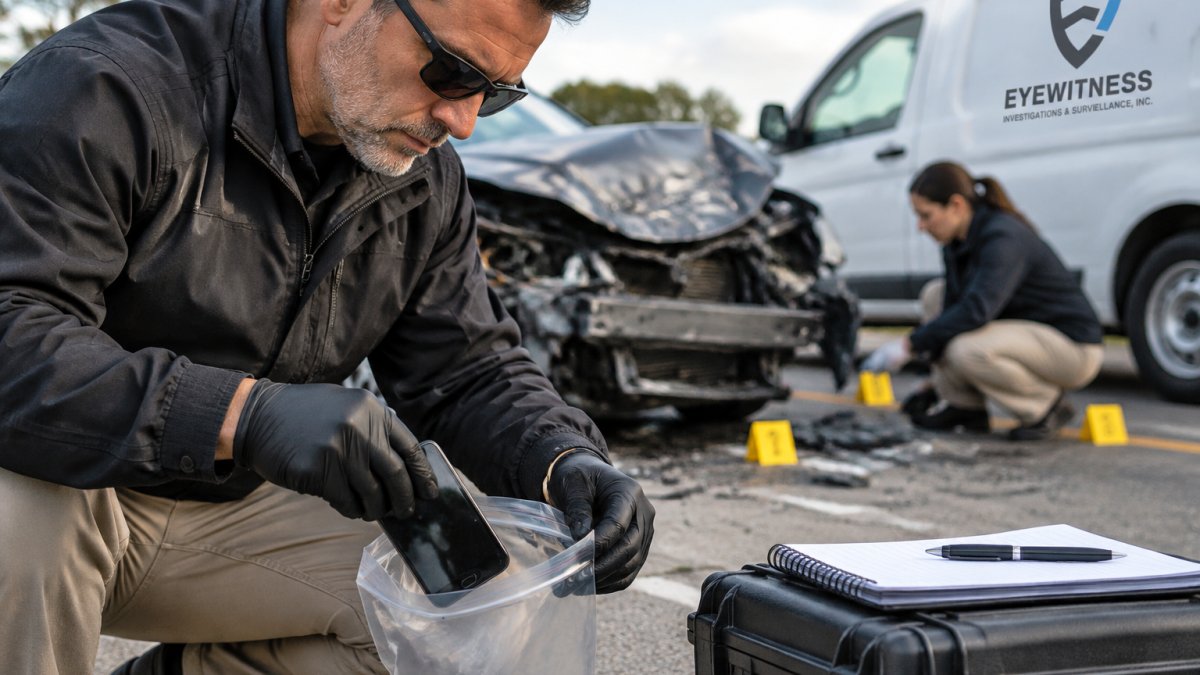
Start with the scene. An investigator photographs the road, the vehicles, and the surrounding area. They note traffic signals, road conditions, and sight lines.
Then come the witnesses. A common mistake is waiting too long to reach them. Memories shift, and people become harder to find.
A solid evidence package usually includes:
Signed witness statements
Scene photographs from multiple angles
Vehicle damage documentation
Public and private surveillance footage requests
Pro Tip Request surveillance footage in writing within days of a crash. Many businesses overwrite their camera systems on a short cycle, and once it's gone, it's gone.
Insurance Claim Surveillance: How Investigators Verify Injury Claims
Insurance claim surveillance is the process of discreetly observing a claimant in public to verify whether their reported physical limits match their actual activity. It's legal when conducted from public vantage points, and it's one of the most common tools in injury investigations.
An insurance company or defense attorney typically orders this kind of investigation when a claim looks inconsistent with the medical records or the claimant's own statements. The goal isn't to trap anyone. It's to document a factual contrast that an adjuster or a jury can weigh.
What Surveillance Actually Documents
A well-run surveillance assignment produces more than a single clip. A complete file usually includes:
Time-stamped video of the claimant's daily activities
Photographs showing physical capabilities (lifting, bending, driving, walking distances)
A written activity log noting times, locations, and observable behavior
Documentation of travel and routines across multiple days
Mileage and route records that corroborate the footage
One thing most guides miss: surveillance rarely "proves" fraud on its own. It shows a contrast. If someone claims they can't lift their arm, and video shows them loading a truck, that contrast matters to an adjuster and an attorney. The investigator's job is to document the contrast cleanly, not to editorialize about it.
The Legal and Ethical Limits That Protect the Case
Surveillance has hard limits, and good investigators respect them. Observing someone from a public street, sidewalk, or parking lot is generally allowed. Trespassing onto private property, harassing a claimant, or recording where state law forbids it is not.
The rules vary by state, and recording consent law is the most common trap. The Reporters Committee for Freedom of the Press guide to recording laws breaks down how consent works across jurisdictions, and a competent investigator knows the rule in the state where the work happens.
What investigators should never do:
Trespass on private property, including fenced yards and posted land
Harass, intimidate, or follow a claimant in a way that creates a confrontation
Misrepresent themselves as law enforcement or as a government official
Record audio or video where state law forbids it
Enter a home or a private medical facility under false pretenses
Ethical work protects the case. Evidence gathered the wrong way can be suppressed, can expose the client to a counterclaim, and can hand the other side a narrative about overreach. A disciplined investigator stays on public ground, documents only what is observable, and lets the footage speak.
Watch Out If an investigator suggests entering private property, posing as law enforcement, or recording in a state that requires all-party consent, stop the assignment. The short-term footage is not worth the long-term damage to the claim.
How the Findings Reach the Attorney
Surveillance material is most useful when it arrives in a form counsel can actually use. That means a clean report with a summary of observations, a timeline, indexed video clips, and a chain-of-custody record for the original files. An attorney can then decide whether to use the material in negotiation, in a deposition, or at trial. The investigator documents; the attorney argues.
Traffic Accident Investigation: Reconstructing What Happened
Traffic accident investigation rebuilds a crash from physical evidence, and it is one of the few areas where a private investigator can add depth that a routine police report does not. This is a specialized field, and it's where experience separates defensible work from guesswork.
Reconstruction answers basic questions. How fast was each vehicle going? Where did the impact happen? Who had the right of way? What did the driver see, and when?
What a Reconstruction Actually Uses
A reconstruction is only as good as the evidence behind it. Common inputs include:
Scene photographs and measurements taken before the scene is cleared
Vehicle damage documentation, including crush depth and direction of force
Skid marks, gouges, and debris fields that indicate speed and impact point
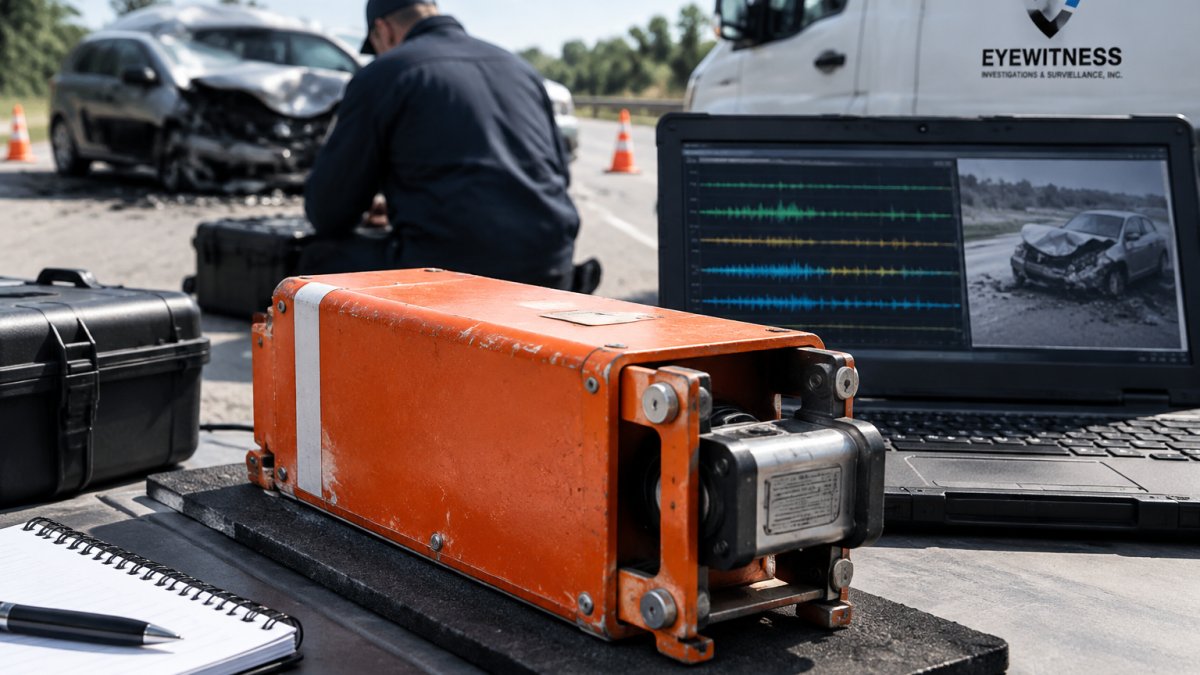
Event data recorder (EDR) data, sometimes called the vehicle's "black box," when it can be lawfully retrieved
Surveillance or dashcam footage from nearby businesses or vehicles
Witness statements taken while memories are fresh
Weather, road condition, and sight-line documentation
Each input has limits. Skid marks fade. EDR data is not available on every vehicle and may require consent or a court order to access. Witness memory shifts within days. The investigator's job is to gather what exists, document its condition, and be honest about what the evidence can and cannot support.
Evidence Handling and Courtroom Use
This is the part most service pages skip. Reconstruction findings are only useful if the underlying evidence can survive scrutiny. That means:
Original photographs and video are preserved, not just edited copies
A chain-of-custody log tracks who handled each item and when
Measurements and calculations are documented so another expert can review them
The report separates observed facts from the investigator's interpretation
An attorney can then assess whether the material is admissible and how to present it. A reconstruction that cannot be explained step by step is a liability, not an asset.
How This Coordinates With Your Attorney
Reconstruction work is most effective when it runs alongside the legal case, not around it. The investigator should share findings with counsel as they develop, flag any evidence that cuts against the claim, and avoid drawing conclusions the attorney has not vetted. That coordination keeps the work useful and keeps the claim from being undermined by an overconfident report.
Our team's background in traffic homicide work means we understand how these scenes are read, and that shapes how we document them. The goal is a factual record an attorney can stand behind.
Private Investigator Cost for Injury Case: Budgeting and Billing Models
Private investigator cost for injury case work depends on the scope, not a flat rate. Most investigators bill hourly, by retainer, or per assignment.
Here's how the main models compare:
Billing Model | How It Works | Best For |
Hourly | Pay per hour worked | Short, defined tasks |
Retainer | Pay upfront, draw down | Ongoing surveillance |
Per assignment | Flat fee per task | One-time scene work |
At Eyewitness Investigations & Surveillance, we offer retainer options so clients know the budget upfront. Our surveillance retainer is $2,400, and we also offer payment tiers at $500, $1,000, $1,500, $2,000, and $3,400. This structure keeps fees predictable instead of open-ended.
Watch Out Avoid any investigator who won't put the billing model in writing before starting. Open-ended hourly work without a cap is how budgets blow up mid-investigation.
How to Choose and Vet a Private Investigator
Choosing the right investigator comes down to licensing, experience, and clear communication. Ask direct questions and expect direct answers.
Run through this checklist before you hire:
Confirm the investigator is licensed in your state
Ask about their background and years in the field
Request a written scope and fee structure
Ask how they handle evidence and chain of custody
Confirm they'll coordinate with your attorney
Check how they protect confidentiality
The Florida Department of Agriculture and Consumer Services licensing portal lets you confirm a private investigator's license status before you sign anything.
Confidentiality is a fair concern. A discreet investigator keeps findings between you and your attorney until you're ready to use them.
Key Takeaway The best investigator is the one who tells you what they can and cannot prove before you pay. If they promise a guaranteed outcome, walk away.
Legal and Ethical Limits of Surveillance in Personal Injury Cases
Surveillance has hard limits, and good investigators respect them. Observing someone in public is generally allowed. Trespassing, harassment, and illegal recording are not.
The rules vary by state. The Reporters Committee for Freedom of the Press guide to recording laws breaks down how recording consent works across jurisdictions.
What investigators should never do:
Trespass on private property
Harass or intimidate a claimant
Misrepresent themselves as law enforcement
Record where state law forbids it
Ethical work protects the case. Evidence gathered the wrong way can be thrown out and can damage the client who hired the investigator.
Conclusion: Using Investigation Evidence to Strengthen Your Claim
The hardest part of an injury claim is often the gap between what someone says and what the evidence shows. Closing that gap takes methodical, factual work, and that's exactly what we do.
Eyewitness Investigations & Surveillance brings investigative experience since 1992, a licensed team, and specialized crash and traffic homicide expertise to every case. We help you establish facts, confront fraudulent activity, and give your attorney solid evidence for legal and insurance proceedings.
Book Now with Eyewitness Investigations & Surveillance and get clarity you can act on.
Frequently Asked Questions
Can a private investigator help with a personal injury claim?
Yes. A private investigator can gather evidence that supports or challenges a personal injury claim. This includes surveillance footage, witness statements, accident scene documentation, and activity monitoring. For example, if an insurance company alleges a claimant is exaggerating injuries, an investigator can document their physical capabilities and daily activities. The evidence collected can be used in negotiation or litigation to verify facts and strengthen your case.
Is it legal to use a private investigator for a personal injury case?
Yes, it is legal to hire a private investigator for a personal injury case. Investigators must follow laws regarding privacy, trespassing, and harassment. They cannot break into homes or place tracking devices on vehicles without consent in many states. Public observation and photography from public spaces are generally allowed. Always choose a licensed investigator who understands the legal boundaries of surveillance and evidence gathering.
How much does a private investigator cost for a personal injury case?
Costs vary based on the complexity and duration of the investigation. Eyewitness Investigations & Surveillance offers retainer options starting at $500, with higher retainers for extensive surveillance or specialized services like traffic homicide reconstruction. For example, a surveillance retainer is $2,400. Billing is often hourly or by retainer, and you should clarify rates and expected expenses upfront to avoid surprises.
What evidence can a private investigator collect for an injury claim?
Investigators can collect video surveillance, photographs, witness statements, and background information. They may document a claimant's physical activities, such as lifting or running, to compare with claimed limitations. They can also gather evidence from accident scenes, locate witnesses, and obtain public records. All evidence must be legally obtained to be admissible in court, so investigators work within legal limits.
Book Now

Comments